Muscles that feel equally “stiff” do not all have the same quality of stiffness when touched, and they do not all change in the same way after we respond.
Examples of different qualities of stiffness include a dry, wood-like stiffness, a soft and spongy feel, and a tight, full state. In Zeroka Seitai, we check these differences in feel, along with elasticity, how far the stiffness extends, and how the muscle responds as it is engaged and relaxed.
Rather than judging from a single characteristic, we compare several cues with the movement and with the changes after our response, and plan where to work, what to do, and in what order.
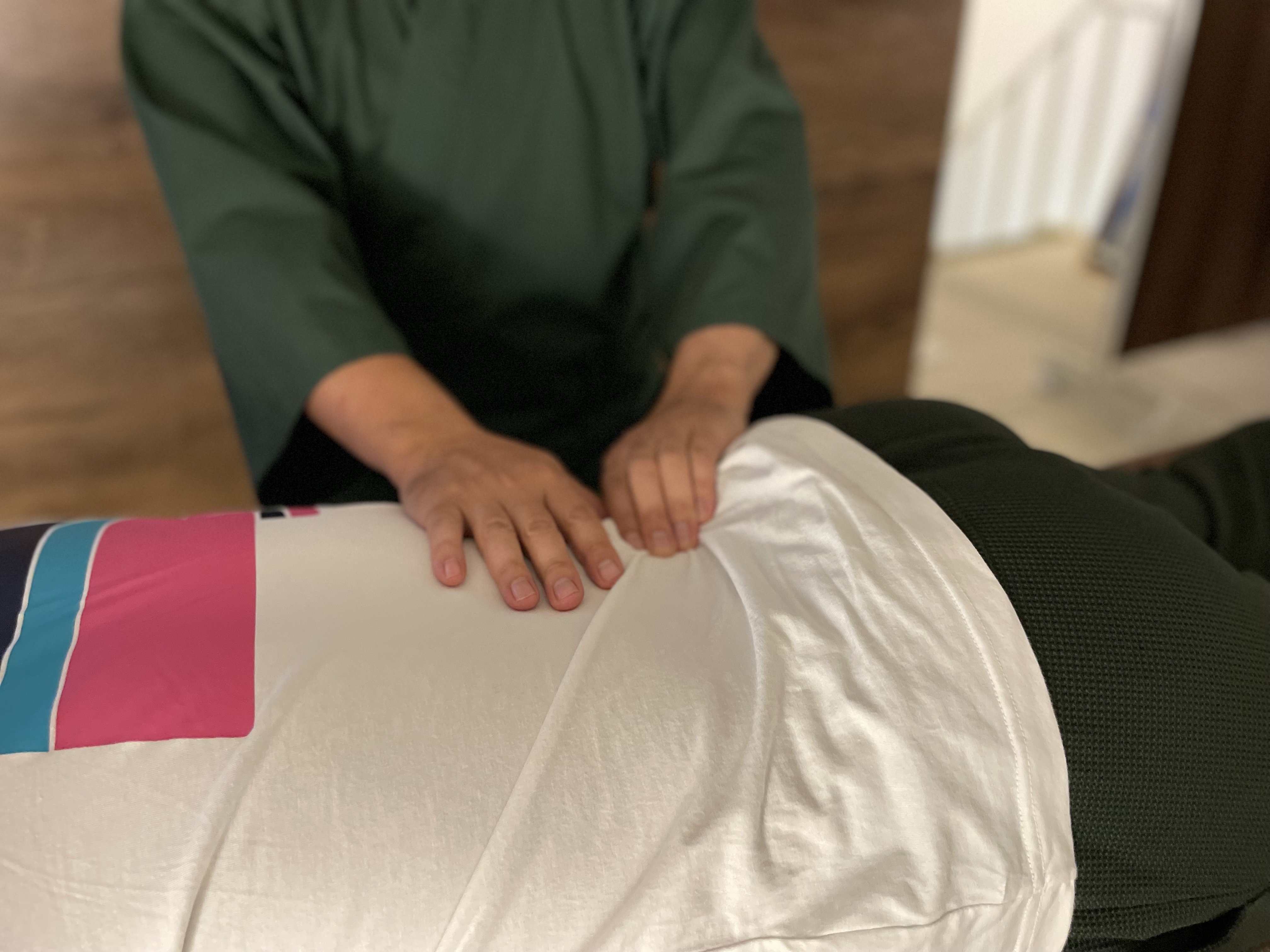
Using the quality of stiffness as a cue for choosing a response
We consider the possibility that several factors overlap in stiffness. When one response does not bring change, we reconsider not only the method but also the target and the sequence.
Figure A-2-1 sets out examples of what Shion has felt by touch and how we interpret the background to each. A stringy, sinewy feel, a state in which individual muscles are hard to distinguish by touch, and a feel of grains or lumps are also cues we use when deciding how to respond.
Differences in the “quality of stiffness” felt by touch
Categories and interpretations based on Shion’s practice
- Stringy, sinewy feel
- Individual muscles are hard to distinguish by touch
- Cartilage-like feel (provisional)
- Spongy feel
- Feel of small grains within the muscle
- Feel similar to a ganglion cyst
We may also interpret both kinds of problem as overlapping.
- Dry, wood-like feel
- Response to the supply side
- A spongy feel may then appear
A schematic for imagining how stiffness feels. “Supply side” and “clearance side” are interpretations, not measurement results. It does not depict actual tissue, or establish a diagnosis or a cause.
“Clearance” here is our working term for the carrying away of what builds up in the muscle. It does not identify a specific substance or a measured process. The comparison with a ganglion cyst describes a feel under the hands; it does not mean that a cyst has been diagnosed.
Rechecking feel and movement, and updating the interpretation
We form a rough interpretation from what we feel and choose the area, method and sequence. After responding, we check changes in the muscle and in movement, then check the quality of stiffness again. As shown in Figure A-2-2, we repeat this cycle and keep updating our interpretation and response.
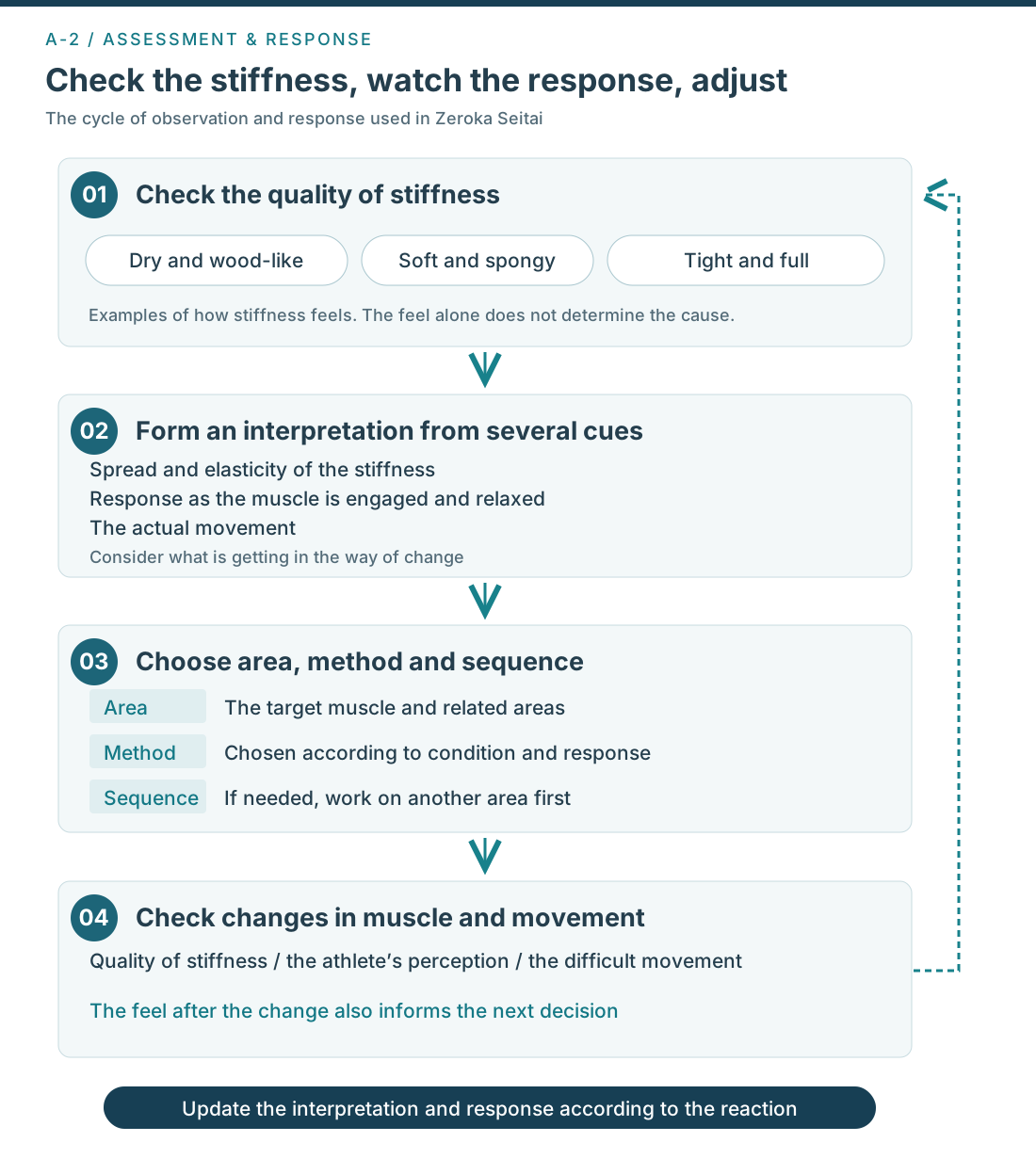
Palpation is a cue for forming an interpretation. We do not measure or establish blood flow, ATP levels or similar from the feel alone. The framework for organising the causes of stiffness is explained in R-4.
How do the differences we find change our response?
The following are examples of judgements and responses we have made in practice. This is not a list linking each feel to a single cause; it shows how what we observe leads to a response.
| What we observe | Zeroka Seitai’s interpretation | How it shapes our response |
|---|---|---|
| Differences in the quality of stiffness, the way it is tight, or its elasticity | We consider that the background to the stiffness, or the overlapping factors, may differ | We do not apply the same response to everything; we choose the method and sequence |
| For example, a dry, wood-like stiffness | We consider that a problem related to blood supply may be prominent | As well as that area, we check the upstream areas we consider related to supply |
| The muscle does not soften enough even after we work on muscle lock | We consider that other factors preventing it from softening may remain | Rather than continuing to work on the same area, we consider other areas or a different sequence |
| Muscles other than the injured area are also stiff, and those muscles are compensating in movement | We consider that the muscles that were compensating may also still be under strain | We check the injured area and related areas, and respond while watching the effect on movement |
What matters is using what changed, and how, as the basis for the next decision.
For example, in an area that first felt dry and wood-like, a spongy feel may appear after we respond with a supply-side problem in mind. In that case, we consider the possibility that factors which were hard to detect from the first feel are overlapping, and we review our next response.
What we are checking here is a change in feel. We keep the observed change separate from our interpretation of its background.
Example | When an area resists change, work on another area first
Sometimes a target muscle does not soften easily even after we work on muscle lock.
If the quality of the stiffness and the way it responds lead us to judge that factors related to blood supply are prominent, we also check areas we consider related to that muscle’s blood supply. For the leg, we may work around the groin area first.
In our practice, we have seen muscles that had resisted change soften more readily after we first worked on another area.
We think improved blood supply plays a part in this change. However, what we check is change in stiffness and movement; we have not directly measured the change in blood flow itself.
From practice | Why we do not add massage at the same time when we suspect a supply-side problem
During technique development, we also tried combining release work with massage. In doing so, we experienced cases where the muscle changed at the time but the stiffness returned the next day or the day after.
For this reason, when we judge that a supply-side problem is involved, we work on the factors that prevent the muscle from softening and place importance on checking whether the athlete’s body changes without adding massage.
This is an experience from technique development; it has not been established by a comparative trial that combining massage caused the stiffness to return. When massage or other care is given priority instead is explained in C-2.
Checking changes in the muscle through to changes in movement
Even if the stiffness changes, we review the remaining issues if the movement the athlete found difficult has not changed. We also check the athlete’s own perception and actual movement, and use that response in our next interpretation. A specific example checked with changing direction is described in A-3.
Note | Points of contact with existing research
Animal studies and other research have examined changes in muscle stiffness associated with changes in circulation, and fibrosis and fat formation in muscle tissue [1, 2]. Such research helps us think about the background to the changes we see in practice. However, it does not directly demonstrate the categories of feel described here or the changes brought about by our hands-on work.
- [1] Kim et al. (2023): an experiment in pigs examining venous congestion in relation to muscle stiffness and electrical activity. Original article
- [2] Uezumi et al. (2011): a study, including mouse models of muscle disease, of progenitor cells involved in fibrosis and fat formation in muscle. Abstract of the original article